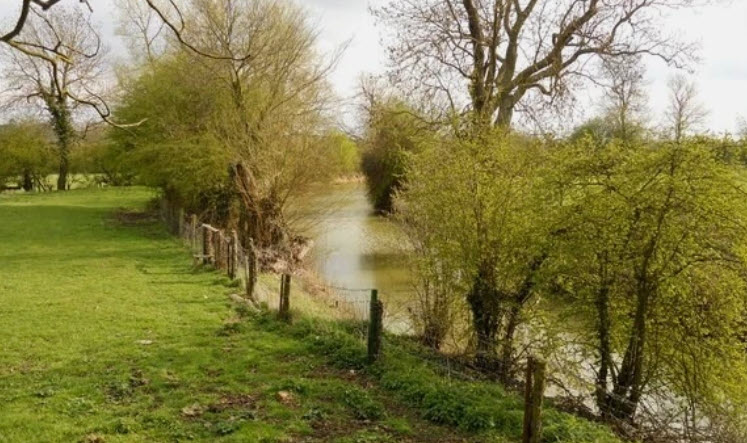
Wolfhampcote is one of Warwickshire’s most evocative “lost villages”, a place where an isolated church and a handful of buildings stand amid fields that once held a thriving medieval community.
Early origins and Domesday
Wolfhampcote is recorded in the Domesday Book of 1086 under the name Ufelmescote, when it was held by Turchill, the Saxon Earl of Warwick who retained large estates after the Norman Conquest. The Domesday survey notes that there was already a priest here, which strongly suggests that a church stood on or near the site of the present building nearly a thousand years ago. No fabric from this earliest church survives above ground, but the Domesday entry fixes Wolfhampcote firmly as an established parish community by the late 11th century.
In 1248 Geoffrey de Langele, lord of the manor, appointed a chaplain named Henry to serve the parish, and by 1256 the living was presented to Peter de Leycestria, a notable pluralist connected with St Mary’s Church in Warwick. These records show that Wolfhampcote was fully integrated into the medieval ecclesiastical structure, with a resident clergyman supported by a manorial patron and linked to the powerful collegiate church at Warwick. The manorial rights and the “living” of the church would shape village life over the next four centuries as they passed between prominent local families.
Manor, landowners and enclosure
In the early 14th century the manor of Wolfhampcote passed by marriage from the Langley family to the Petos, a Warwickshire family who became important patrons of the church. Sir John Peto granted the living to Thomas de Beauchamp, Earl of Warwick, in 1365, and in 1392 the Earl in turn gave the church to the Dean and Canons of St Mary’s, Warwick, further tightening the link between this rural parish and the county town’s great collegiate foundation. During the 14th century the church itself was largely rebuilt, reflecting both the resources of its patrons and the continued importance of the village.
In 1614 Sir Edward Peto of Chesterton sold the manor to his tenant Robert Clarke, beginning nearly two centuries of Clarke family ownership. The Clarkes remained lords of the manor until 1800, and several memorials in the church testify to their status and to the presence of a resident gentry family at the heart of the parish. Meanwhile, changes in agriculture were reshaping the landscape: documentary evidence shows that by 1501 an enclosure had taken place, and a royal inquiry of 1517 described the village as “in ruinam positam”, in a state of ruin.
These enclosures, part of a wider trend in late medieval and early modern England, saw open fields converted to pasture for sheep, displacing villagers and contributing to the settlement’s gradual abandonment. Aerial photographs and partial excavation reveal the earthwork remains of the deserted settlement: a moat, hollow ways (sunken lanes), building platforms, fishponds and enclosures, all characteristic features of a once‑busy medieval village now reduced to humps and lines in the turf.
Deserted village and local legend
By the 16th century Wolfhampcote was on its way to becoming a deserted medieval village, one of many such sites across Warwickshire and the Midlands. Local legend later claimed that the community was wiped out by the Black Death, supposedly brought by refugees fleeing plague in London, or else destroyed during the Civil War by Cromwell’s troops. However, historians and archaeologists have found no evidence in the extensive surviving records to support these dramatic tales.
The more likely explanation is quieter but no less poignant: after the great plagues and amid economic change, a dwindling number of cottages remained occupied until their inhabitants gradually drifted away to more prosperous settlements where land was easier to cultivate. The lord of the manor then cleared the remaining holdings for sheep pasture, leaving the old village site under grass much as it remains today. The land is now protected from damage by arable farming under arrangements between the landowner and the state, recognising the archaeological significance of the earthworks.
St Peter’s Church: hard shell, soft heart
The most striking survivor of the lost village is St Peter’s Church, which stands alone in a field, approached by a track and surrounded by rough‑tufted grass and the faint lines of former streets and houses. The earliest visible fabric in the present building dates from the 13th century in the north aisle and chapel, with a major rebuilding in the 14th century and alterations to the roof and clerestory in the 15th century. After the Dissolution of the Monasteries, the tower was added in the later 16th century, and in 1690 the top of the tower was altered and re‑roofed, the date and initials of the churchwardens still visible on the west crenellations.
From the outside the church has been described as having a “hard shell”, with crooked windows, stout buttresses and patchwork stonework giving it a tough, almost defensive character. Inside, however, the limewashed walls, large windows and treasures such as the beautifully carved 14th‑century screen, Queen Anne royal arms, Victorian Hood mausoleum and rustic chancel roof create a serene, light‑filled interior. The church continued to serve not only the tiny remnant of Wolfhampcote but also the nearby hamlets of Flecknoe, Nethercote and Sawbridge long after the main village had disappeared.
By the 20th century St Peter’s had become redundant as a regular parish church, and in 1960 it was listed Grade II* for its special architectural and historic interest. It is now under the care of the Churches Conservation Trust, which has restored and maintains the building, describing it as “a church with a hard shell and a soft heart” and welcoming visitors who make the pilgrimage out across the fields. Services are still held occasionally, such as carol concerts and special events supported by local volunteers and friends’ groups.
People, life and the parish today
Although the original village site is abandoned, Wolfhampcote remains a civil parish in the Rugby district of Warwickshire, straddling the boundary with Northamptonshire along the River Leam. The parish includes the old village earthworks together with the nearby village of Flecknoe and the hamlets of Sawbridge and Nethercote, with a combined population of under 300 people at the 2021 census. Flecknoe is now the main focus of everyday life, while at Wolfhampcote itself only a farmhouse, an old vicarage (built in 1873) and a restored late‑19th‑century cottage stand near the church.
For residents and visitors, the landscape is shaped as much by movement as by absence: two disused railway lines run close by, and a flourishing canal (the Oxford Canal) lies nearby, echoing later chapters of rural and industrial history layered onto the medieval core. Walkers, church enthusiasts and local historians are drawn to the site to explore the earthworks, photograph the lonely church and imagine the former life of streets, houses and farms now reduced to patterns in the grass. Community groups and conservation bodies work together to protect both the building and the archaeological remains, ensuring that Wolfhampcote’s story as a deserted village, a place of worship and a quietly beautiful corner of Warwickshire continues to be told.