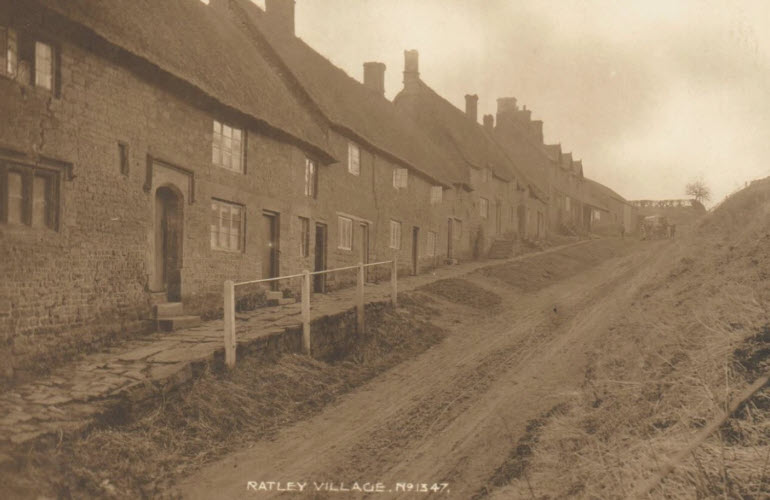
Ratley is a hilltop Warwickshire village whose long history, dramatic Civil War connections, and distinctive church of St Peter ad Vincula give it a character out of proportion to its size.
Life here has been shaped by its exposed position on Edge Hill, its farming traditions, and a close community that has adapted old buildings and institutions to modern needs while keeping a strong sense of place.
Setting and early history
Ratley stands high on the north‑west side of the Edge Hill escarpment, about 200 metres above sea level, close to the Oxfordshire border and around seven miles north‑west of Banbury. The village forms part of the civil parish of Ratley and Upton, which had a population of 327 at the 2011 census, underlining its continuing identity as a small rural community.
The origins of Ratley are medieval, with evidence of a 12th‑century motte‑and‑bailey castle just outside the village, now a Scheduled Monument. Archaeological work and landscape traces also point to a medieval settlement pattern that included features such as fishponds, used for breeding and storing fish as part of the manorial economy.
Manors, castle and landscape
The remains of Ratley’s motte‑and‑bailey castle are a reminder that this was once a defended site, reflecting the unsettled conditions of the 12th century when many such timber‑and‑earthwork fortifications were thrown up across England. Though now reduced to earthworks, the castle mound and surrounding features still shape the field patterns and footpaths on the edge of the village.
Over time the castle ceased to have a military role, and Ratley settled into the rhythm of an agricultural parish with open fields, later enclosed, and small farms clustered around its lanes under Edge Hill. The proximity of Upton House less than a mile away – now a National Trust property housing an important art collection – added a country‑house influence to local employment and landscape.
Civil War and Edge Hill
Ratley stands close to one of the most famous battlefields of the English Civil War, Edge Hill, where Royalist and Parliamentarian armies clashed on 23 October 1642. The open country between Edge Hill, Kineton and the surrounding villages, including Ratley, formed the stage for this first major pitched battle, with villagers witnessing troop movements and the noise of cannon from their fields and lanes.
The fighting caused damage in the area, and later accounts record that the parish church at Ratley suffered during the Civil War, with repairs only fully addressed in the 19th century. Today, the story of Edge Hill and its ghosts, viewpoints and memorials remains part of the local identity, drawing visitors who often pass through Ratley on their way to the escarpment.
St Peter ad Vincula church
At the spiritual and historical heart of Ratley is the Church of England parish church dedicated to St Peter ad Vincula, one of only a small number of English churches with this dedication. The name, meaning “St Peter in chains”, refers to the biblical account of St Peter’s imprisonment and liberation, and links the village indirectly to the more famous chapel of the same name in the Tower of London.
The church sits in the lowest part of the village and is built of local Hornton stone in a style that blends Norman and Early English work with later Decorated Gothic alterations. The chancel dates from about 1190, with the nave and tower added in the 13th century; at that time the interior would have been lit by narrow lancet windows, some of which survive in altered form.
During the 14th century, significant changes were made: the earlier narrow windows were replaced with wider openings and more elaborate tracery, and two chapels were added on the south side of the church. Plans for further remodelling were probably halted by the impact of the Black Death in the mid‑14th century, which slowed parish church building across much of England.
In the 16th century the wall between the two south chapels was removed to create a single south aisle, supported by a distinctive pier arcade that remains an unusual architectural feature of the building. The north porch is a 17th‑century addition, and damage sustained during the Civil War was repaired towards the end of the 19th century, completing the layered appearance of the church seen today.
Inside, the church preserves memorials, carved details and fittings that chart the life of the parish over many centuries, from medieval stonework to Victorian restoration. The churchyard, wrapped around the building, continues to serve as a place of burial and remembrance, holding the stories of generations of Ratley families.
Village life, people and buildings
For most of its history, Ratley’s people lived from the land, combining arable farming, grazing and, in the 20th century, mineral extraction linked to the ironstone quarries on Edge Hill. In 1922 the Edge Hill Light Railway was constructed through the parish to carry ironstone, leaving traces in the fields alongside Camp Lane even after its closure and dismantling in 1946.
The village once had its own Church of England school and Post Office; both buildings still stand but have been converted into houses, reflecting wider changes in rural services while preserving the village streetscape. The Victorian period brought increasing prosperity and saw the building of Methodist and Wesleyan chapels in Ratley, adding nonconformist strands to local religious life.
In the 20th century, Viscount Bearsted of Upton House played a notable role in community life by donating the village hall in 1935, providing a focus for meetings, events and social gatherings that continues today. More recently, the Parish Plan of 2007 recorded local priorities, concerns and ideas, demonstrating a strong sense of involvement among residents in shaping their village’s future.
Modern Ratley remains a small, close community, with many historic houses and cottages adapted for contemporary living but retaining traditional materials and forms. The combination of spectacular views from Edge Hill, nearby attractions such as Upton House, and the quiet, time‑layered presence of St Peter ad Vincula means that visitors often find more history here than they expect from a village of just a few hundred people.