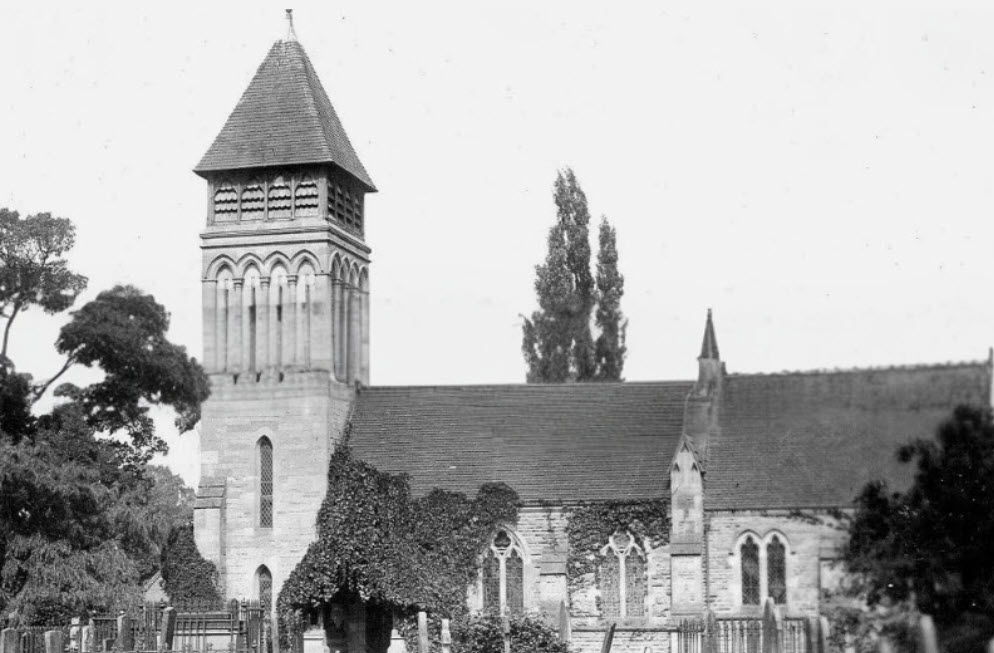
Old Milverton is a small, picturesque Warwickshire hamlet on the edge of Leamington Spa, where centuries of farming, estate life and quiet parish worship have unfolded in a bend of the River Avon.
With its historic church of St James, traces of a medieval village and links to nearby Guy’s Cliffe House, it offers a surprisingly rich story for such a modest settlement.
Setting and early origins
Old Milverton lies east of Warwick and north‑west of Leamington Spa, set mainly on high ground looking down towards a large loop of the River Avon. The civil parish, which had a population of 319 at the 2011 census, preserves what remains of the ancient parish of Milverton after much of it was absorbed by the expansion of Leamington.
The area has been farmed intensively since Stone Age times, and archaeological finds in the parish include flint tools, a prehistoric sherd, a 3rd‑century Romano‑British coin, a cropmark and a Bronze Age ring ditch. Milverton itself is recorded in the Domesday Book of 1086 under the name “Malvertone”, showing that a settled community was already in place here soon after the Norman Conquest.
Medieval village and estate landscape
Today’s compact cluster of houses around the church stands on the site of a larger medieval village, now classed as a “deserted” or “shrunken” settlement whose outlines can still be traced in nearby fields. Over the centuries, changes in farming, population and estate management led to the contraction of the original village into the smaller hamlet seen now.
Old Milverton developed within a classic estate landscape, with farms, cottages and a few substantial houses associated with nearby seats such as Milverton Hall and Guy’s Cliffe House. The parish today comprises the hamlet itself, surrounding farmland and several large country houses, some of which have since been converted into apartments or institutional uses.
Guy’s Cliffe House and local influence
Guy’s Cliffe House, standing just outside the hamlet on a dramatic cliff above the Avon, has long had a strong influence on Old Milverton. The stone chapel at Guy’s Cliffe was built in 1430 by Richard Beauchamp, Earl of Warwick, and a Tudor house later grew up there before being replaced around 1751 by Samuel Greatheed’s Palladian‑style mansion.
For much of the 18th and 19th centuries, Guy’s Cliffe functioned as a major local estate, and many of the houses in Old Milverton were built for estate workers employed there and on surrounding farms. The gardens of Guy’s Cliffe are now a Site of Special Scientific Interest, but historically they formed part of a working landscape that shaped employment, housing and daily life in the hamlet.
St James’s Church and spiritual life
At the centre of Old Milverton stands the church of St James, a mid‑Victorian rebuilding on the site of a much older medieval church and chapel. Milverton’s church was originally linked with Leek Wootton: in 1122 Geoffrey de Clinton granted Leek Wootton church to his new priory at Kenilworth, and the chapel of Milverton was understood to be included in this grant.
From 1232 the church belonged to the Augustinian canons of Kenilworth, a relationship that lasted until the dissolution of the abbey in 1539, giving Milverton three centuries of monastic patronage. Parish records surviving from 1742 onwards list baptisms, marriages and burials, capturing the names of Old Milverton families over nearly 300 years, while at least one weathered grave‑stone in the churchyard predates the surviving registers.
By the 19th century the old church had fallen into poor condition, leading to a major restoration and rebuilding funded by Lady Charles Bertie of Guy’s Cliffe. Work in 1878–80, to designs by architect John Gibson (who had previously worked with Sir Charles Barry), left only the foundations and lower part of the tower from the earlier building; the new church was re‑opened on 28 August 1880.
St James’s, as rebuilt, is a sandstone church in an Early English Gothic style with a distinctive pyramidal tower roof and arcading around the upper storey. Hollington stone is used for quoins and tracery, and the building has seen sensitive later additions, such as a glazed screen installed in the south porch to mark the Millennium in 2001, engraved with a scallop‑shell motif symbolising St James and medieval pilgrimage to Santiago de Compostela.
Village life, people and buildings
For most of its history, Old Milverton’s people lived from the land as farm workers, smallholders and estate staff, with Parkhouse Farm and other holdings forming key parts of the local economy. Parkhouse Farm itself is a mid‑18th‑century Grade II listed farmhouse built in sandstone ashlar, representing the more substantial farmsteads that anchored the parish’s agriculture.
Many of the houses in the hamlet were built in the late 19th century for estate workers, explaining the consistent style and materials of several cottages clustered near the church. Until mains water arrived relatively late in the village’s story, residents relied on their own wells and roof‑water cisterns, with communal wells, including one at the village hall and another on Old Milverton Road, serving those without private supplies; the surviving village pump recalls this era.
In the later 20th century and into the 21st, Old Milverton has seen some change: new uses have been found for big houses (including conversions to apartments), and developments such as a nursing home, hospital and conference centre have appeared within the wider parish. Even so, the overall character remains rural and small‑scale, with open farmland, lanes and the church still defining the hamlet more strongly than modern additions.
Old Milverton today
Modern Old Milverton sits physically close to Leamington Spa yet feels psychologically a world away, thanks to its small size, surrounding fields and the bend of the Avon cutting it off from urban sprawl. The joint parish council of Old Milverton and Blackdown works to preserve this distinct identity, emphasising the area’s long agricultural history, its medieval and prehistoric remains, and the importance of the church, farms and estate houses in shaping local character.
For visitors, the hamlet offers a quiet church, views over the Avon valley and walks linking Guy’s Cliffe, Milverton Hall and the surrounding countryside; for residents, it remains a place where historic buildings are still lived in and where community life centres on church, hall and farm in much the same way as it did for earlier generations. Old Milverton’s story is one of continuity amid change – a small, enduring rural settlement on the very edge of a growing town.