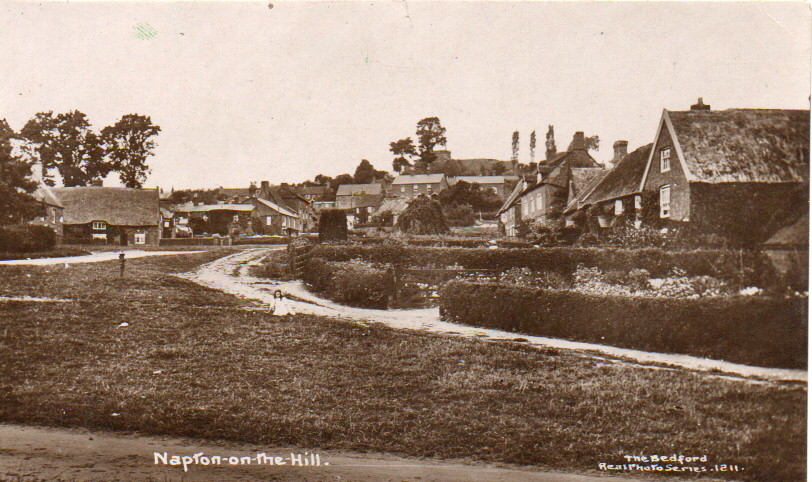
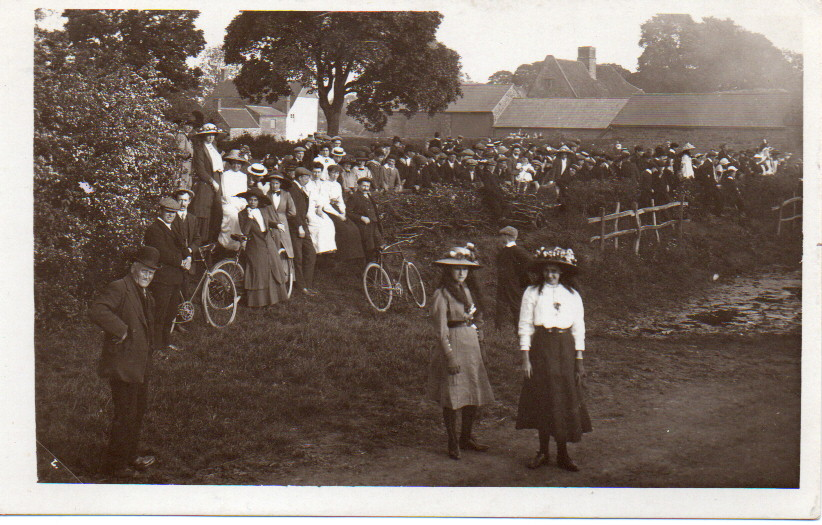
Napton-on-the-Hill is an ancient south Warwickshire hilltop village whose history, life, and people have been shaped by its prominent position, its church and windmill, and later by canals and brickmaking.
Origins and early history
Archaeological finds show that people have been active around Napton Hill since at least the Neolithic and Bronze Age, drawn by the vantage point and natural springs. The village name comes from Old English, from a word meaning “hilltop” or “knap” and “tun” for “settlement”, so Napton essentially means a settlement on the hill. In the Domesday Book of 1086 it appears as “Neptone”, when Robert de Beaumont, later Earl of Leicester, held the principal manor as part of his Midland estates.
Medieval Napton grew into one of the largest settlements in Warwickshire, helped by its market and good farming land around the hill. In 1321 King Edward II granted Robert de Napton a charter for a weekly Thursday market and a fair around the Feast of the Assumption in August, confirming its status as a local centre for trade and gathering. By about 1400 there were around 1,000 people in the parish, very similar to the modern population, which shows how large and stable a community it was by late medieval times.
Church, faith, and community
The Church of St Lawrence crowns the summit of the hill and has been at the heart of village life for centuries. Parts of the church date back to the 12th century, with later additions as the parish prospered, and its position means the tower is visible for miles across the South Warwickshire landscape. Local folklore says the builders originally tried to put the church at the foot of the hill, but each night the stones were mysteriously moved uphill, so the final church was raised on the summit where it stands today.
Inside the churchyard are generations of Napton families, farmers, craftspeople, canal workers, and more recently newcomers who settled in the village. Among the best-known modern names is the American actor Ed Bishop, who lived in Napton for several years and is buried there, linking this old parish to international film and television history. The church has hosted the usual pattern of village baptisms, weddings, and funerals, but also harvest festivals and remembrance for those lost in war, anchoring the spiritual and social life of the community.
Windmill, agriculture, and brickworks
Napton’s skyline is dominated by its windmill, one of Warwickshire’s most recognisable landmarks. There was a mill recorded on the hill by 1543, and the present stone tower mill probably dates from the 18th or early 19th century, working by sail until around 1900 and then by steam until 1909. The mill served local farmers by grinding their grain and helped make Napton a focal point for surrounding hamlets; today it is restored and privately owned, but still a symbol of the village’s working past.
Behind the windmill the ground bears scars of the brickworks that once provided significant employment. The brickworks were begun in 1885 by Nelson, Watson & Co., taking advantage of local clay and the nearby canal, and at their peak they employed about 110 people and had their own wharf. Traditional bricks and tiles from Napton were shipped out by barge, and the works stayed in operation until 1973, so several generations of Napton families had at least one relative connected to the brickyard.
Canals and working lives
The arrival of the Oxford Canal in 1774 transformed life and work around Napton. Engineer Samuel Simcock cleverly routed the canal around three sides of Napton Hill to reduce the number of locks, and later it linked with the Grand Union Canal at Napton Junction, effectively wrapping the village in a “moat” of waterways. This brought coal and goods in and allowed local produce, bricks, and livestock to go out, connecting Napton’s people to the wider industrial Midlands.
Canal families, such as the Cocks family who worked as carpenters at Napton Locks for more than a century, formed a distinct community alongside older farming and craft traditions. In the 19th century the census shows a thriving mix of occupations: in 1811 there were 205 houses and 787 inhabitants, and by 1851 the village supported bakers, blacksmiths, grocers, shoemakers, about 17 farmers, and 20 graziers working the surrounding pastures. These trades, together with domestic servants, school staff, and craftsmen, created a self-contained rural economy where most daily needs could be met within the parish.
Population and village character
Over the centuries, Napton’s population has risen and fallen but remained remarkably stable in broad terms. After medieval growth to around 1,000 people, numbers dipped and rose with agricultural changes and enclosure, but 19th- and early 20th‑century figures show between roughly 787 and 951 inhabitants. By 2001 the population was 808, rising to 898 in 2011 and to 1,063 in the 2021 census, with a mid‑2024 estimate of about 1,111 residents.
Modern Napton still blends old stone and brick cottages with newer homes, giving a mix of long-established families and newcomers attracted by the scenery and community life. Amenities are surprisingly numerous for a village of this size: there are several pubs, a social club, sports facilities, fishing pools, a village shop and post office, canal-side businesses, and campsites, which together keep social life lively and support tourism from boaters and walkers. The village today remains closely tied to its landscape, with footpaths, hedged fields, and views across multiple counties from the hilltop reinforcing that sense of continuity with its rural past.
Notable residents and today’s community
Alongside its many unsung farm and canal families, Napton has attracted a few better-known names. The BBC’s rural affairs correspondent Tom Heap lives in the village, linking the parish’s agricultural heritage with contemporary media coverage of countryside issues. The presence of such residents alongside lifelong locals reflects how Napton has balanced change with continuity, welcoming new people while keeping a strong village identity.
Today the community continues to record and celebrate its own story through local history projects and parish initiatives. The Napton History Project and neighbourhood plan documents draw on memories of residents, parish records, and archives, preserving details of school life, farm work, celebrations, and charities so that future generations can understand how the village evolved. In this way, the history, life, and people of Napton-on-the-Hill remain very much alive, written not only in its church and windmill but in the everyday experiences of those who live and work there now.