Leamington Spa in the fashionable days
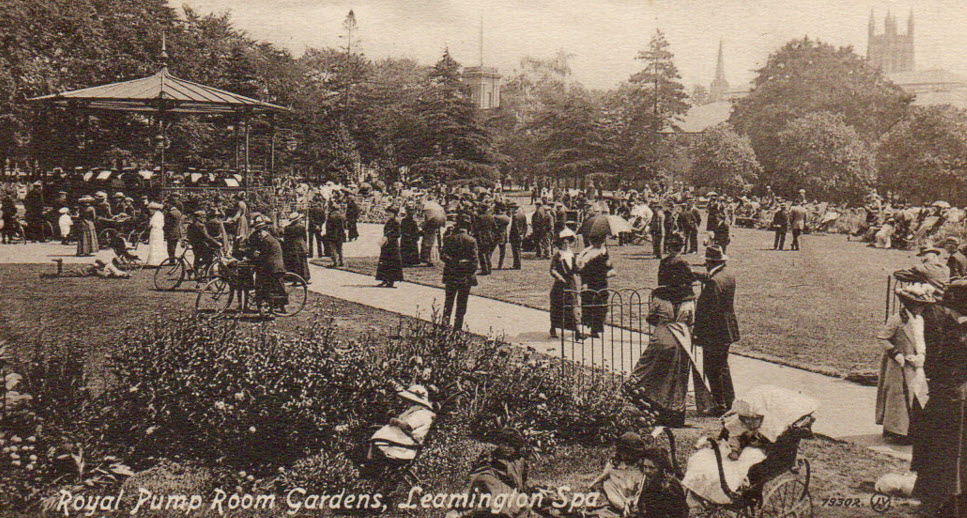
Early Origins: Leamington Priors
Saxon Roots: Originally an Anglo-Saxon settlement called Leman-tūn (“farm on the River Leam”), it was first recorded in the Domesday Book (1086) as Lamintone.
Priory Control: For 400 years, the village was under the control of Kenilworth Priory, earning it the name Leamington Priors.
Medicinal Waters: While salt-water springs were recorded as early as 1480, they were mainly used for bread-making and preserving meat until their medicinal potential was popularised in 1784 by Benjamin Satchwell and William Abbotts
The Regency Boom (1784–1840) Rapid Expansion:
Between 1801 and 1851, the population exploded from just 315 to over 15,000 as “taking the waters” became very fashionable.
The Royal Prefix:
Following a visit by Princess Victoria in 1830, Queen Victoria granted the town the “Royal” prefix in 1838,
officially renaming it Royal Leamington Spa
Key Landmarks:
The Royal Pump Rooms (1814) became the town’s social heart.
Regency Architecture:
The town centre, including the Parade and Clarendon Square, was developed with the elegant white-stucco terraces that still define its character today.
The Birth of Tennis: Leamington is home to the world’s first lawn tennis club, founded in 1872 by Major Henry Gem and Augurio Pereira.Industrial Shift:
As spa popularity waned, the town pivoted to manufacturing. The Eagle Foundry (est. 1851) began producing the iconic AGA Rangemaster stoves, a business that still operates today.
Regency Parks:
The Jephson Gardens were opened in 1834, providing recreational space for visitors and residents alike.
Digital Hub:
In the late 20th and early 21st centuries, the town became a global centre for video game development, earning the nickname “Silicon Spa”.
Notable Residents:
The town was the childhood home of Sir Frank Whittle, inventor of the jet engine, and has hosted famous figures like Charles Dickens and Napoleon III.