Barcheston is a small Warwickshire parish on the River Stour whose story reflects many of the wider changes in rural England, from medieval manors and mills to enclosure, depopulation and quiet twentieth‑century farming life.
Setting and early history
Barcheston lies just north‑east of Shipston‑on‑Stour, with its parish covering about 1,555 acres (around 629 hectares) and embracing two settlements: Barcheston itself, where the church, rectory, manor house and mill stand, and the neighbouring hamlet of Willington. The village developed on the west bank of the Stour, benefitting from good meadow land and a mill recorded as early as Domesday, which together underpinned a classic mixed farming economy for many centuries.
By the thirteenth century the parish was divided into several manors held by local gentry families, and a resident de Bercheston family appears in records from 1208, exercising the right of advowson – the privilege of presenting the rector to the parish church – and taking a role in county administration, including the collection of royal taxes. Their presence shows Barcheston was woven into the wider structures of medieval Warwickshire, with obligations to crown and church shaping village life as much as the rhythms of the agricultural year.
Medieval village life and the Black Death
Like many Midland settlements, Barcheston’s modest prosperity in the fourteenth century was checked by the Black Death and subsequent outbreaks of plague. Although no poll tax records survive for the parish itself, neighbouring communities show marked population decline, and by 1428 Barcheston was taxed as having fewer than ten households, a stark indication of contraction.
For ordinary villagers this would have meant abandoned holdings, merged strips in the open fields, and perhaps opportunities as well as hardship, as surviving tenants could negotiate better terms on land and labour. At the same time, the Hundred Years War and later the Wars of the Roses rumbled through national politics; although no fighting is recorded in the parish, shifting loyalties among the regional gentry had knock‑on effects on tenures and local authority in Barcheston.
Enclosure, depopulation and the Sheldons
By the late fifteenth and early sixteenth centuries, pressure to turn arable land into more profitable pasture transformed the village more dramatically. In 1507, William Willington, a wealthy wool producer and wool stapler, purchased the manor and enclosed some 530 acres, depopulating much of Barcheston and forcing about 24 villagers to leave their homes in search of work and food elsewhere.
Willington’s rise was typical of Tudor social mobility: he built up a broad estate portfolio across Warwickshire, Gloucestershire and Oxfordshire, and sought to cement his status by marrying his seven daughters into established county families. One of these daughters, Mary Willington, married William Sheldon around 1535, a union that brought Barcheston into the orbit of the influential Sheldon family and led to the foundation of the first English tapestry manufactory at Barcheston Manor, a remarkable industrial venture for a quiet rural parish.
The Sheldon tapestry workshops, established at Barcheston in the mid‑sixteenth century, produced high‑quality woven maps and hangings that were famous in their day and are now highly prized survivals of English Renaissance craftsmanship. The manufactory appears to have closed by about 1611, but the manor itself remained with the Sheldons until the early nineteenth century, and their leases, improvements and investments shaped farming and housing patterns in the parish for generations.
The church of St Martin
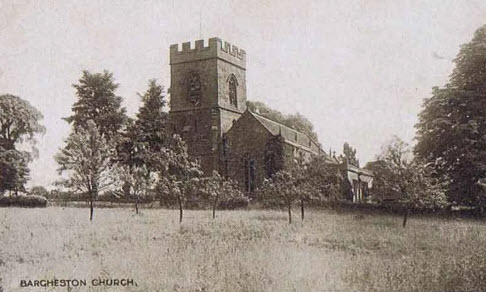
At the heart of the village stands the church of St Martin, the oldest surviving building in the parish and an eloquent record of Barcheston’s long history. The present nave and chancel date from around 1190–1200, though there may have been an earlier structure on the site, while a north aisle was added about 1220, replacing an earlier transept or chapel whose blocked doorway is still visible.
Over the following centuries the building was enlarged and altered in response to both liturgical change and local patronage. A south porch of likely fourteenth‑century date provided shelter at the main entrance, and a south aisle‑chapel, built in the early sixteenth century, probably owes its existence to William Willington; his large alabaster tomb dominates this chapel, accompanied by other sixteenth‑ and seventeenth‑century monuments that testify to the continuity of local gentry families. The chancel walls were substantially rebuilt in the fifteenth and eighteenth centuries, the font dates from the early fourteenth century, and all the roofs are modern, reflecting ongoing repair and care into the modern era.
Today, St Martin’s remains a living centre of worship within a group of south Warwickshire parishes, offering regular Holy Communion or Morning Prayer using both the Book of Common Prayer and Common Worship. A new pipe organ installed in 2019 has allowed the church to host organ recitals and concerts, so that music now complements worship as a key part of village and parish life.
Notable families, millers and farmers
Beyond the Willingtons and Sheldons, a succession of lesser‑known but equally important families, tenants and tradespeople sustained Barcheston across the centuries. The medieval de Bercheston family held one of the manors until the late fourteenth century before their fortunes waned and legal disputes in the 1490s saw them lose their claim to the Duraunt family, illustrating how fragile gentry status could be when title deeds and alliances slipped from one’s grasp.
The village mill, recorded in 1086 and again in 1217 when it was tenanted by Simon de Barcheston, remained a focal point of work and sociability, its ownership traceable through the nineteenth and early twentieth centuries. In the eighteenth century, leases from the Sheldon estate show Barcheston manor house largely demolished, with its remaining buildings occupied rent‑free by a poor villager, while surrounding lands were let to several farmers, including members of the Brent, Brayn, Watkins and Wincot families. These documents reveal the practical details of rural life: tenants at will alongside those on long terms, conditions about not ploughing particular meadows, even the obligation on one tenant to keep a hound or pointer for the landlord and to haul several tons of coal from Shipston to Weston each year.
Village life in the modern era
By the eighteenth and nineteenth centuries Barcheston had settled into the pattern of a small agricultural community, its population modest and often described in gazetteers as a village and parish in the Shipston‑on‑Stour district. Open‑field systems had long since given way to enclosed farms, with holdings such as Barcheston Grounds Farm emerging from earlier closes with evocative names like Long Ground, Hovel Ground and Long Pool Close, each representing a piece of the parish’s working landscape.
The twentieth century brought further change but little expansion, and Barcheston today remains a quiet settlement whose identity is bound up with its church, its long farming tradition and its links to nearby Shipston. Community life now revolves around the rhythms of church services, occasional concerts, and the everyday interactions of a small population, with the river, fields and scattered farmsteads providing continuity with the village’s medieval and early modern past. For visitors and residents alike, Barcheston offers a layered sense of time: a medieval church with a Norman core, a manor once famous for tapestries, fields reshaped by Tudor enclosure, and a modern parish that has retained its rural character into the twenty‑first century.