Ashow is one of those Warwickshire villages that still feels like a village should – small, friendly, slightly tucked away – with a sense that the past is never very far beneath the surface. If you like places where the church still anchors the community, the fields come right up to the back gardens and everybody more or less knows everybody else, Ashow is very much that kind of place.
Where Ashow sits in the landscape
You find Ashow about two and a half miles south‑east of Kenilworth, just off the B4115 Coventry Road and close to the A46/A452 roundabout, yet once you turn into the village it feels quietly removed from all that modern traffic. The parish lies on generally flat, low‑lying land between about 60 and 80 metres above sea level, with the River Avon forming the southern edge and giving a soft, pastoral feel to the surrounding fields. With only around 51 houses, the village itself is compact: a short street of cottages and former farmhouses, the little church, and a scatter of agricultural buildings that remind you this was – and in many ways still is – a working rural landscape. Unlike many villages which have sprawled outwards with post‑war estates and infill, Ashow has largely escaped twentieth‑century expansion, so its shape on the map is still recognisably that of an older farming settlement. You can stand on the lane by the church, look out over the paddocks and the Avon meadows, and get a view that would be broadly familiar to someone visiting in the nineteenth century, and probably earlier.
Ashow in the records – from “Asceshot” onwards
The documentary trail picks up Ashow very early on, in the Domesday Book of 1086, where it appears under the name “Asceshot.” That entry tells us that by the late eleventh century this was already a recognisable community, with its farmland assessed and taxed along with other manors in the area. Over the medieval period the story of Ashow is closely bound up with Stoneleigh and the religious houses that dominated local landholding; by the time of Edward IV the manor had been granted to the Abbey of Stoneleigh, placing the village’s fate firmly in monastic hands until the Dissolution. The pattern of open‑field strips, common meadows and later enclosures, which you can still sense in the lines of hedges and footpaths today, grew out of those centuries of manorial and ecclesiastical control. Nearby Bericote, now essentially a depopulated hamlet, was once part of this same manorial landscape, so Ashow’s history is best seen as part of a small cluster of settlements rather than a completely isolated unit.
By the nineteenth century the village shows up in sources like John Marius Wilson’s “Imperial Gazetteer of England and Wales,” which paints a picture of a modest agricultural parish on the Avon, with 1,012 acres, a population of 149 and 40 houses. Wilson notes that the property was “not much divided,” meaning that landownership was concentrated in relatively few hands, and that the rectory (then in the diocese of Worcester) was a valuable living, reflecting the significance of the church in local affairs. In other words, this was never a big place, but it was stable, productive and firmly rooted in the traditional structures of rural Warwickshire.
The village church – heart of the community
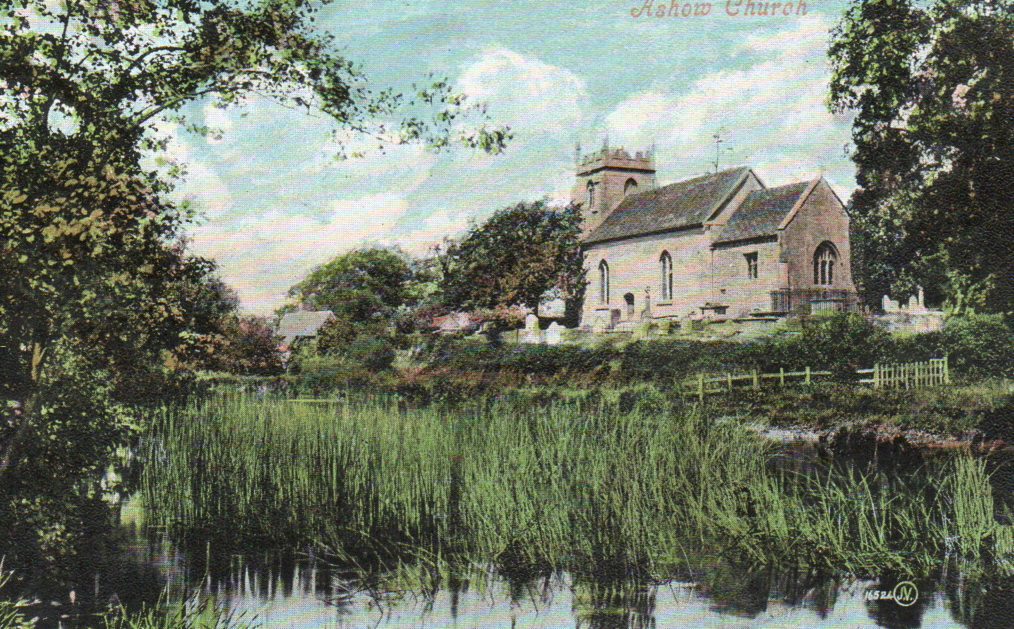
The focal point of Ashow, both on the ground and in the historical record, is the small parish church of the Assumption of Our Lady. It dates back to the early 12th century, putting its origins firmly in the Norman period, and even today the building retains the simple dignity of a country church that has grown gently rather than grandly. Over the centuries you would have seen changes – repairs, restorations, adjustments to the interior – but the essential role of the church as the village’s spiritual and social centre has remained remarkably constant.
In earlier times Ashow functioned as a chapel within the wider ecclesiastical structure, later gaining full parish status as the local population and resources justified a separate living. The rectory, valued at £295 in the nineteenth century, came with responsibilities not only for services and pastoral care but also for local charities, which by Wilson’s day amounted to £45 a year – a useful sum for the relief of the poor and for village good works. Walk around the churchyard today and, in the sequence of headstones and family names, you glimpse the continuity of village life: farming dynasties, labouring families, people who lived and died within sight of the same tower and the same line of poplars by the river.
Mills, fields and working lives
Although there is no industry in Ashow now – no factory chimneys, no workshops – the village and its neighbour Bericote once supported three mills. These would almost certainly have been watermills on local streams or channels feeding the Avon, central to the grinding of grain and, by extension, to the village economy. A mill was more than a piece of machinery; it was a meeting point, a workplace and a marker of local status, and the fact that Ashow had several tells us that this was a productive agricultural area.
As milling became more centralised and industrial processes shifted away from small rural sites, those local mills faded out of use, and by the twentieth century they had disappeared as functioning businesses. The countryside, however, remained in use; the fields recorded as 1,012 acres of parish land in the nineteenth century are still very much present in the modern landscape, even if farming methods and ownership patterns have changed. Today, tractors and modern machinery have replaced horse‑drawn ploughs, but the essential rhythm of sowing, growing and harvest still shapes life around the village. Many residents now work in nearby towns such as Kenilworth, Leamington Spa, Warwick or Coventry, commuting in by car rather than walking to a local farm or mill, yet they come home each evening to a place that still looks and feels like the countryside.
People of Ashow – then and now
One of the striking things about Ashow is how small and stable its population has remained. The 2001 Census recorded 104 residents in the parish, rising only slightly to 108 in 2011, which is not a significant change over a decade. That earlier nineteenth‑century snapshot of 149 people and 40 houses suggests that, if anything, the village may have been a little busier in Victorian times than it is today, though the basic scale has always been modest. Back then you would have found a community composed largely of farmers, agricultural labourers, domestic servants and small tradespeople – the sort of mix you see repeated across rural Warwickshire.
Fast‑forward to the present and the occupational picture is more varied. With no employment base in the village itself, modern Ashow functions as a classic commuter settlement: residents travel to offices, schools, workshops and hospitals elsewhere, and a good number are likely to be retired. What has not changed, however, is the sense of everyone knowing one another; in a village of around fifty houses, anonymity is difficult, and relationships – whether friendly, familial, or occasionally fractious – form a web that connects household to household. You could imagine a child growing up here, walking to the church for Christmas services, playing in the same lanes that earlier generations used, and then going away to study or work, only to return later in life to one of the same cottages that have served Ashow families for decades.
Ashow today – a quiet, timeless feel
Modern Ashow is perhaps best defined by what it does not have. There is no pub, no village shop, no school and no major employer within the parish boundary, which is unusual by national standards but part of the reason the village retains such a calm, residential character. Visitors sometimes assume this means “nothing happens,” but local life tends to revolve around home, the church, and activities shared with neighbouring communities rather than around a traditional hub like the inn or post office.
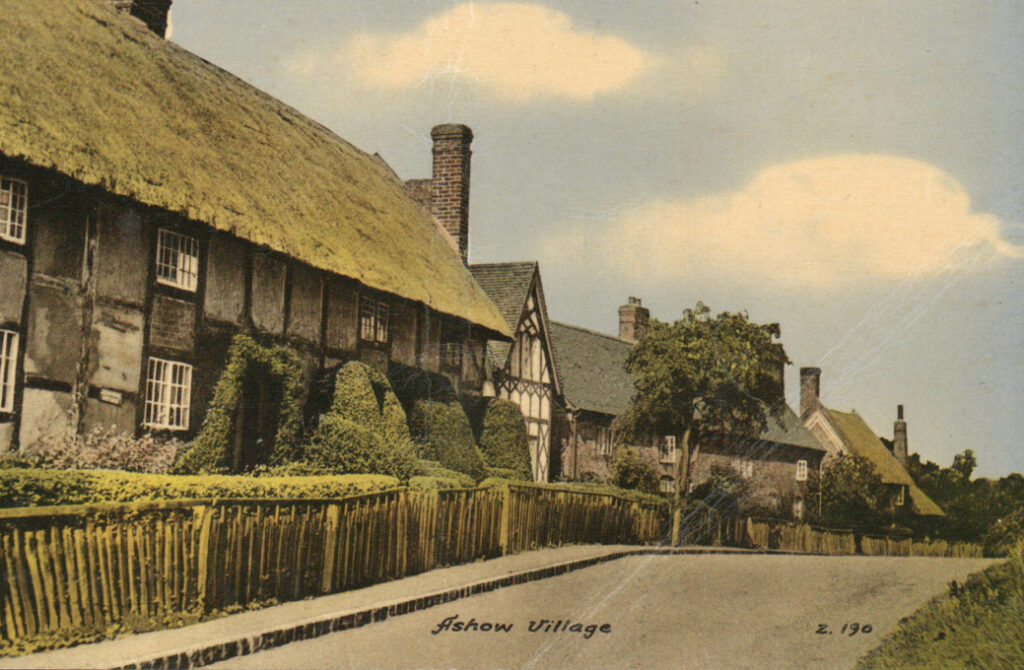
The housing stock remains modest in scale, with older cottages and farmhouses fronting onto the lane, many built in local stone or brick and set behind low walls or hedges. There are no sprawling housing estates or big modern developments to break the line of roofs and gardens, and the transition from village to open country is sudden – a few houses, then fields, with the Avon meadows beyond. The B4115 and the A46 are close enough to make commuting straightforward, yet they are far enough away that the immediate soundscape is more birds and tractors than lorries. For people who enjoy a slower pace of life, but still want good access to Kenilworth, Leamington or Coventry, this balance between seclusion and connectivity is a large part of Ashow’s appeal.
Walk through the village on a summer evening and you can easily imagine earlier generations doing much the same: church door open for a service, smoke drifting from cottage chimneys in cooler weather, perhaps a dog barking in a farmyard just beyond the main street. It is this blend of continuity – from “Asceshot” in the Domesday Book to Ashow in the twenty‑first century – that gives the village its atmosphere: not a museum piece, but a living community that has managed to carry a large piece of its past into the present with very little fuss.