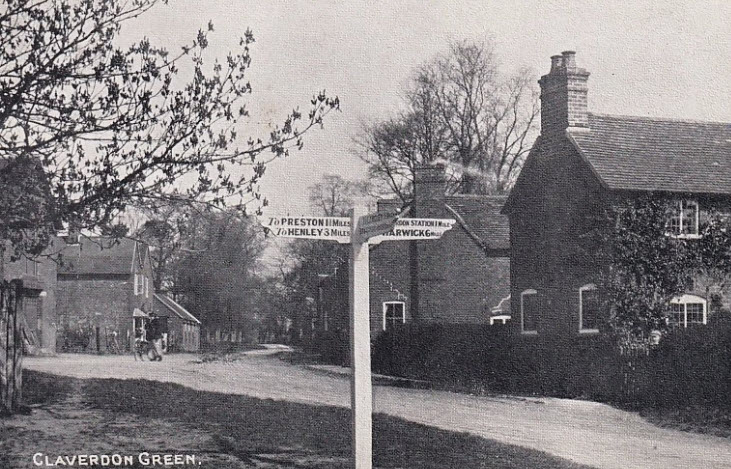
Claverdon is a small but historically rich village in south‑east Warwickshire, lying about five miles west of Warwick amid gently rolling farmland and woodland.
Its name comes from Old English roots meaning “clover hill”, a reminder that this was originally a scattered agricultural community clustered around a prominent rise in the landscape. Today the village and parish remain rural in character, but modern transport links and housing growth mean that Claverdon combines a long and layered past with the life of a thriving commuter and community village.
Early history and manors
Claverdon appears in the Domesday Book of 1086 as a substantial manor held by Robert de Beaumont, later Earl of Leicester, with land for five ploughs, meadow, woodland and a recorded priest, indicating an established settlement and early church. The Domesday entry lists villagers, smallholders and slaves, underlining the typical Norman manorial structure where lordship, agriculture and religion were closely intertwined.
In the later Middle Ages the estate passed to the powerful Earls of Warwick and formed part of a larger block of Arden estates that also included neighbouring manors such as Kington, Langley and Songar within the wider parish. Periods of forfeiture and royal control in the 14th and 15th centuries, notably after the downfall of Thomas de Beauchamp in 1397, saw the manor granted to and then recovered from royal favourites before returning to the Warwick line under Henry IV.
The 16th century brought another major change when John Dudley, Earl of Warwick and later Duke of Northumberland, acquired the lordship, only for it to be forfeited after his execution in 1553; his widow Joan held it for life before it passed in 1568 to Sir John Spencer, ancestor of the later Spencer family of Althorp. Under these owners Claverdon remained predominantly agricultural, with open fields, meadows and woodland providing the basis of local life and employment.
Parish church and religious life
The reference to a priest in the Domesday survey suggests there was a church here by the 11th century, though the present parish church of St Michael and All Angels dates in its earliest fabric from the 12th century. The oldest visible parts of the standing building are from the 14th century, while its striking west tower, in late medieval English Gothic style, belongs to the 15th century and dominates views of the village from the surrounding countryside.
Like many rural churches, St Michael’s was heavily restored in the 19th century, and in Claverdon’s case it was largely rebuilt twice, leaving a structure that mixes medieval tower and fragments with mainly Victorian nave and chancel. The church has long served a wide rural parish that historically included Langley and the chapelry of Norton Lindsey, and its parish registers, which begin in the late 16th century, record baptisms, marriages and burials that trace centuries of local families.
In the 20th and 21st centuries the church has continued as a focus of spiritual and community life, hosting worship, festivals, social events and commemorations for village residents. In 2025, for example, the church community helped to honour four First World War soldiers from the village whose names had been missing from the original war memorial, adding a new plaque and biographical research that connected present villagers with the sacrifices of earlier generations.
Village life and occupations
In the early 19th century Claverdon was described as an extensive rural parish on the Hatton–Stratford railway (later in the century), with the hamlet of Langley included and agriculture as the main occupation. Population in 1811 stood at around 400, rising to 485 inhabitants and 96 houses by 1821, figures that suggest a dispersed pattern of farms and cottages rather than a tightly nucleated village street.
Trades and crafts that supported this rural economy included blacksmithing, with the village smithy—now a listed building—dating from the late 17th century and still in use as a working smithy well into the 20th century. Local engineering and agricultural firms such as the Langley‑based Troth & Hillson, agricultural engineers active from the mid‑19th to mid‑20th century, also formed part of the parish’s working life, with ledgers and account books preserving a detailed picture of local customers and farm machinery.
The arrival of the railway and the proximity of the Birmingham and Stratford Canal brought Claverdon closer to regional markets and towns, encouraging modest growth and giving villagers easier access to employment beyond agriculture. Over time this helped to shift the village’s character, as commuters and professionals settled alongside farming families, creating a more mixed social and occupational profile while preserving a strong rural identity.
People and community in the 20th century
By the later 19th and 20th centuries, Claverdon had developed a reputation as a pleasant rural parish with a close‑knit community, sustained by its church, school, local businesses and societies. The village contributed men to both world wars, and the memorials in and around St Michael’s bear witness to those who left farms and workshops to serve in the armed forces.
Research behind the 2025 First World War memorial additions uncovered details of four men—Lieutenant Mitchell, Second Lieutenant Price, Lance Corporal Rotton and Gunner Wilkinson—whose stories linked military service with families active in village life, including clergy and lay leaders. These individual histories illuminate how national events such as the Somme offensive, the Balkan campaigns and Western Front trench warfare were experienced through the lives of Claverdon residents.
Village organisations, sports clubs and social groups also flourished in the 20th century, helped by the rail connection and the growth of private transport, which made Claverdon both more accessible and more outward‑looking. While many traditional rural employments declined or mechanised, the community adapted, with residents increasingly working in nearby towns such as Warwick, Stratford‑upon‑Avon and Birmingham while retaining strong attachment to the parish and its institutions.
Claverdon and its people today
In the early 21st century Claverdon has a population of around 1,300 residents, with slow but steady growth recorded between the 2001, 2011 and 2021 censuses. The population structure shows a mix of age groups, with a significant proportion of families and older residents, and the overwhelming majority identifying as White and UK‑born, reflecting its character as a largely rural English village.
Religiously, most residents who state a faith still identify as Christian, indicating that the parish’s Anglican heritage remains influential even as the village becomes more diverse and secular in outlook. St Michael and All Angels continues to offer regular worship and a range of community activities, working with neighbouring parishes in the Arden area to sustain rural ministry.
Modern Claverdon balances preservation and change: historic buildings such as the medieval‑towered church and the old smithy stand alongside newer housing and amenities, while the surrounding fields and hedgerows keep the landscape recognisably that of a traditional Warwickshire parish. With its deep roots in Domesday lordship, medieval manors and centuries of parish life, yet a population that increasingly works and studies across the wider region, Claverdon offers a snapshot of how English village communities have evolved while retaining a strong sense of place and continuity.