Bishop’s Itchington – from medieval field village to busy South Warwickshire community
Bishop’s Itchington is one of those South Warwickshire villages where you can still feel the shape of the old farming landscape, even though the place now functions as a lively, well‑equipped community in its own right. The River Itchen gives the village its name, and the “Bishop’s” part recalls the medieval bishops who once owned and controlled the manor here.
Setting and first impressions
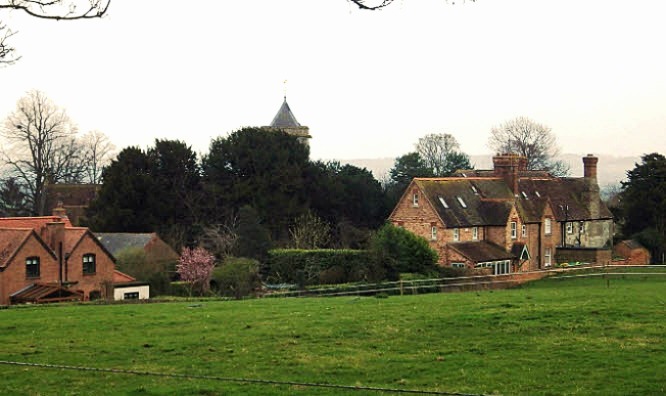
You find Bishop’s Itchington on the B4451 in rolling South Warwickshire countryside, close to Junction 12 of the M40 and about seven miles south of Leamington Spa. That makes it easy to reach, but once you turn off the main road you come into a village that still feels distinct, with a defined centre, older streets and good views out to surrounding fields. The parish lies in gently undulating ground on the Itchen valley, so you get a mixture of higher land, old quarries and lower, greener stretches where the river loops through the landscape. Modern housebuilding has expanded the village over the last few decades, but there is still a sense of arrival when you come in, and a clear edge where the houses stop and farmland begins.
Today the population stands at around 2,000–2,100 people, a sizeable increase on the small agricultural community of earlier centuries. Housing ranges from older cottages and farmhouses at the core to 20th‑century estates and more recent infill, reflecting steady pressures for growth along the M40 corridor. Despite this expansion, Bishop’s Itchington retains a village identity rather than feeling like a swallowed‑up suburb, helped by its facilities, open spaces and the way the older street pattern still anchors the newer development.
Early history and the manors of Upper and Lower Itchington
The story of Bishop’s Itchington goes back at least to Domesday times, when the settlement – then part of the church estates of Coventry – was recorded as a manorial community with land, plough teams and villagers working the open fields. Its toponym, drawn from the River Itchen, shows how closely life was tied to the local watercourse, both as a boundary and as a source of power and meadow land. By 1152 the Bishops of Lichfield had succeeded St Mary’s Priory, Coventry as lords of the manor, and from them the village gained the “Bishop’s” prefix it still carries.
In medieval times there were actually two linked settlements here: Upper Itchington, on the site of the present village, and Nether or Lower Itchington, roughly a mile to the south where Old Town Farm now stands. They shared a common field system, with open‑field strips and common meadows worked by villagers under the manorial regime. Lower Itchington later suffered a dramatic change of fortune: in 1547, Thomas Fisher, a well‑connected land speculator, depopulated the settlement, clearing houses and tenants to turn the land over to more profitable uses. Upper Itchington survived and gradually became what we now know as Bishop’s Itchington, while the site of Nether Itchington slipped into history as a shrunken or deserted village.
The open‑field system continued around Bishop’s Itchington well into the 18th century. Only with the Bishop’s Itchington Inclosure Act of 1774 were the long strips and shared resources parcelled up, allowing landowners to reorganise fields, hedges and access in a more “modern” pattern. Today’s patchwork of fields and lanes, visible on any walk out of the village, is the direct descendant of that re‑planning, even though the underlying pattern of medieval usage still peeps through in hedgerow lines and ridge‑and‑furrow.
Industry, limestone and the cement works
For centuries Bishop’s Itchington was a farming village, but the 19th and early 20th centuries brought a powerful new influence: limestone quarrying and cement production. The parish sits on deposits of Blue Lias limestone, and by the 1800s quarries here and in neighbouring Harbury were feeding a growing cement industry. By 1882 one works near the village had four bottle kilns and was turning out around 120 tons of Portland cement a week, linked by its own railway branch to the Great Western Railway. The complex expanded steadily; by 1907 it boasted 18 chamber kilns producing some 600 tons per week, with extended sidings and a second rail connection threading through the parish.
This industrial phase changed the look and feel of parts of Bishop’s Itchington, as raw material was dug, processed, burned and shipped out in quantity. It also brought jobs and a different rhythm of life to what had previously been a purely agricultural economy. Quarrying eventually extended over the parish boundary into Harbury, creating a wider industrial landscape that local people still remember. The later 20th century saw the decline and closure of the cement works, followed by land reclamation and attempts to soften the scars with planting and landscaping. The industry has gone, but echoes remain in local memories, old photographs and the shape of the ground on the village fringes.
People of Bishop’s Itchington – past and present
In population terms, Bishop’s Itchington has always been modest but not tiny. Around 1801 it was home to roughly 200 people in about 40 households; by the later 19th century the numbers had risen as agricultural improvements and early industrial employment drew in workers. Nineteenth‑century directories list the familiar cast of rural life: farmers, labourers, domestic servants, tradesmen and small shopkeepers, all anchored by the church, local big houses and, later, the cement works.
Personal memories give a flavour of how people lived here even into the mid‑20th century. One account of “The Old Mansion” at Bishop’s Itchington recalls a 16th‑century building still in use as divided accommodation, with water carried in buckets from a communal tap, waste thrown onto the garden and candles used upstairs long after electricity arrived downstairs. That mix of old fabric and modern convenience, and of families adapting old buildings to new uses, is very typical of how the village evolved before large‑scale new housing smoothed out some of the contrasts.
Today the population is around 2,000 and includes a broad social mix: commuters, families with children at the local school, retired people, and residents whose roots go back several generations in the village. Many working adults travel to jobs in Leamington Spa, Southam, Warwick, Coventry or along the M40 corridor, turning Bishop’s Itchington into a classic commuter settlement. At the same time, long‑term residents, strong local institutions and shared memories of the village’s industrial phase give it a sense of identity that goes beyond simply being a housing estate near the motorway.
Village life and facilities today
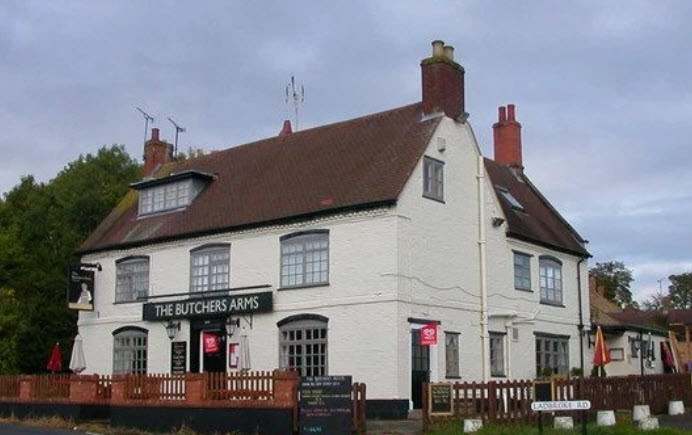
One of the things that sets Bishop’s Itchington apart from some smaller villages is the range of facilities it still supports. There are three shops, a post office, a doctor’s surgery, a pub, a social club and a fish and chip shop, as well as the Bishop’s Itchington Memorial Hall and the Blue Butterfly Community Café in the community centre. The village has its own primary school and a network of clubs, societies and sports teams that help knit residents together. All of this means that daily life can often be lived locally, with larger centres like Southam and Leamington used for bigger shops or specialist services rather than every small need.
Physically, the village combines old and new. The parish church and a scattering of older cottages and farm buildings remind you of medieval and early modern origins, while the 19th‑ and 20th‑century houses speak of growth through the railway and cement eras. Post‑war and recent housing fills in around this core, but green spaces, play areas and footpaths help to keep a sense of openness. Walk out along the lanes and you soon reach countryside where the hum of the M40 is just audible in the distance, a reminder that Bishop’s Itchington now looks both inward to its parish and outward to the wider region.
For residents, that combination of history, facilities and accessibility is the real appeal. Bishop’s Itchington is no longer the small twin‑settlement of Upper and Lower Itchington recorded in medieval documents, nor the quarry‑dominated landscape of the early 1900s, but a village that has carried pieces of each era forward. Families who have been here for generations share the streets with newcomers drawn by the location and amenities, and together they continue to write new chapters in a place whose roots go all the way back to Domesday.