Rugby is a historic market town in the north-east of Warwickshire, best known around the world as the birthplace of rugby football but also valued today for its strong transport links, growing population and mix of traditional and modern neighbourhoods.
For anyone considering life in South Warwickshire, Rugby offers a different flavour to Stratford-upon-Avon: less tourist-focused, more of a working town and commuter hub, yet with a distinctive history and identity of its own.
Early origins and medieval market town
Human settlement around Rugby goes back to at least the Early Iron Age, when its position on a plateau overlooking the River Avon made it a natural defended site on the frontier between ancient tribes. In the Roman period, the nearby town of Tripontium on Watling Street served as a local centre, leaving traces of occupation just a few miles from where Rugby would later grow.
By the Anglo-Saxon period a small settlement had formed here, recorded in the Domesday Book of 1086 as “Rocheberie,” a name thought to derive from an older Celtic phrase meaning “wild hilltop.” The first recorded mention of St Andrew’s Church dates from 1140, and by 1221 Rugby had become a parish in its own right, with the church elevated to full parish status at the heart of a modest rural community.
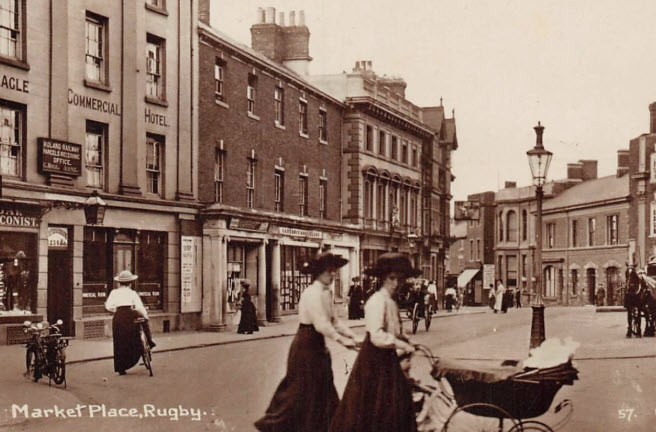
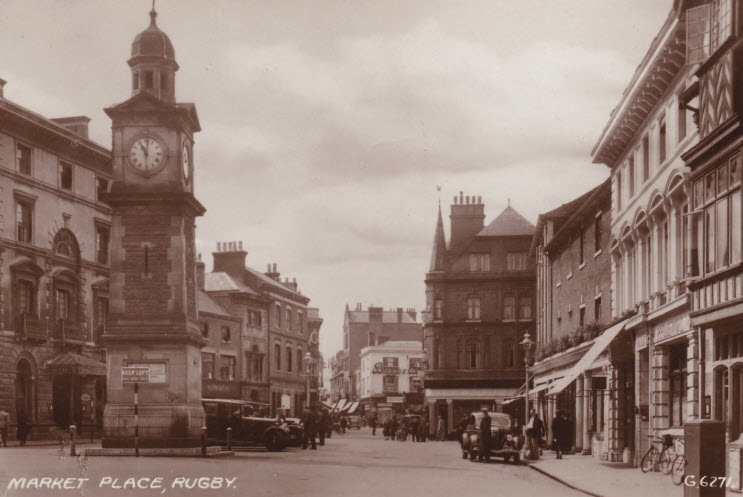
In 1255 Henry de Rokeby, lord of the manor, obtained a charter to hold a weekly market at Rugby, turning the village into a small country market town serving the surrounding farmland. The medieval street pattern around the market place, including High Street, Sheep Street and North Street, still underpins the layout of the town centre today.
Rugby School and a global game
A turning point in the town’s history came in 1567 when Lawrence Sheriff, a locally born grocer to Queen Elizabeth I, left money in his will to found a free grammar school for local boys, which became Rugby School. To support itself, the school gradually took in fee-paying pupils from outside the area and over time developed into one of England’s leading public schools, attracting families from across the country.
The school moved to its current site on the edge of the town in the mid-18th century, onto an eight-acre plot known as the Close, which provided ample space for outdoor games. Under influential headmasters such as Henry Holyoake and later Dr Thomas Arnold in the early 19th century, Rugby School helped reshape English public school education, emphasising discipline, character and organised sport.
Rugby is most famous as the birthplace of rugby football, a game said to have originated in 1823 when schoolboy William Webb Ellis, “with a fine disregard for the rules,” picked up the ball and ran with it during a match on the Close. Whatever the strict truth of the story, it is clear that the school codified the rules of the “Rugby style of game,” with the first written laws produced by three pupils in 1845, and from there the sport spread around Britain and the wider world.
Railways, industry and growth
Until the early 19th century Rugby remained a relatively small, rural market town dominated by agriculture, local trade and the presence of the school. Its fortunes changed dramatically with the arrival of the railways, when the town became a major junction connecting lines between London, the Midlands and the North.
This new role as a transport hub spurred rapid population growth and industrial development, with engineering, electrical and other manufacturing firms establishing themselves in and around the town. Rugby at one stage boasted one of the longest railway platforms in the country, a sign of its importance in the Victorian railway network.
Through the later 19th and 20th centuries the town expanded outwards from its medieval core, with new housing, civic buildings and facilities built to serve a growing workforce and their families. At the same time, Rugby’s association with the sport that bears its name gave it a global profile, drawing visitors to see the school, the chapel and the places associated with the game’s early history.
Rugby today: amenities and everyday life
Today Rugby is a sizeable market town with a busy commercial centre, home to a wide range of shops, cafes, restaurants and services that serve both local residents and nearby villages. Residents have access to several supermarkets, a cinema, leisure centres and parks such as Caldecott Park, as well as retail destinations like Rugby Central in the town centre and Elliott’s Field and Junction One retail parks on the edge of town.
The town provides a broad spread of housing, from Victorian terraces and older properties near the centre to newer estates and family homes in suburbs and nearby communities, offering options for different budgets and lifestyles. Schools are a strong feature, with the independent Rugby School, state secondary schools such as Lawrence Sheriff School (founded to continue Sheriff’s original intention of free grammar education) and a number of primary schools serving the area.
Healthcare provision includes a local hospital and multiple GP practices, while sports clubs, playgrounds and green spaces support active family life. Despite its industrial heritage, Rugby offers easy access to countryside, with nearby Draycote Water providing walking, cycling, fishing and water sports, and the Grand Union Canal and Warwickshire lanes offering attractive routes for exploring.
Living in Rugby within South Warwickshire
Rugby’s location is one of its major strengths: it sits close to the M1, M6 and M45 motorways and lies on a mainline rail route, giving fast links to London, Birmingham and other major centres, which makes it especially appealing to commuters. At the same time it remains surrounded by Warwickshire and neighbouring countryside, with nearby towns such as Daventry and Lutterworth adding further amenities and interest within easy reach.
Within the wider story of South Warwickshire, Rugby stands out as a transport-connected, economically active town with a proud educational and sporting heritage rather than a tourist-led centre. For people thinking about living in this part of the county, it offers a blend of history, practical day-to-day convenience and community spirit, all under the shadow of a school and a game that have carried its name around the world.